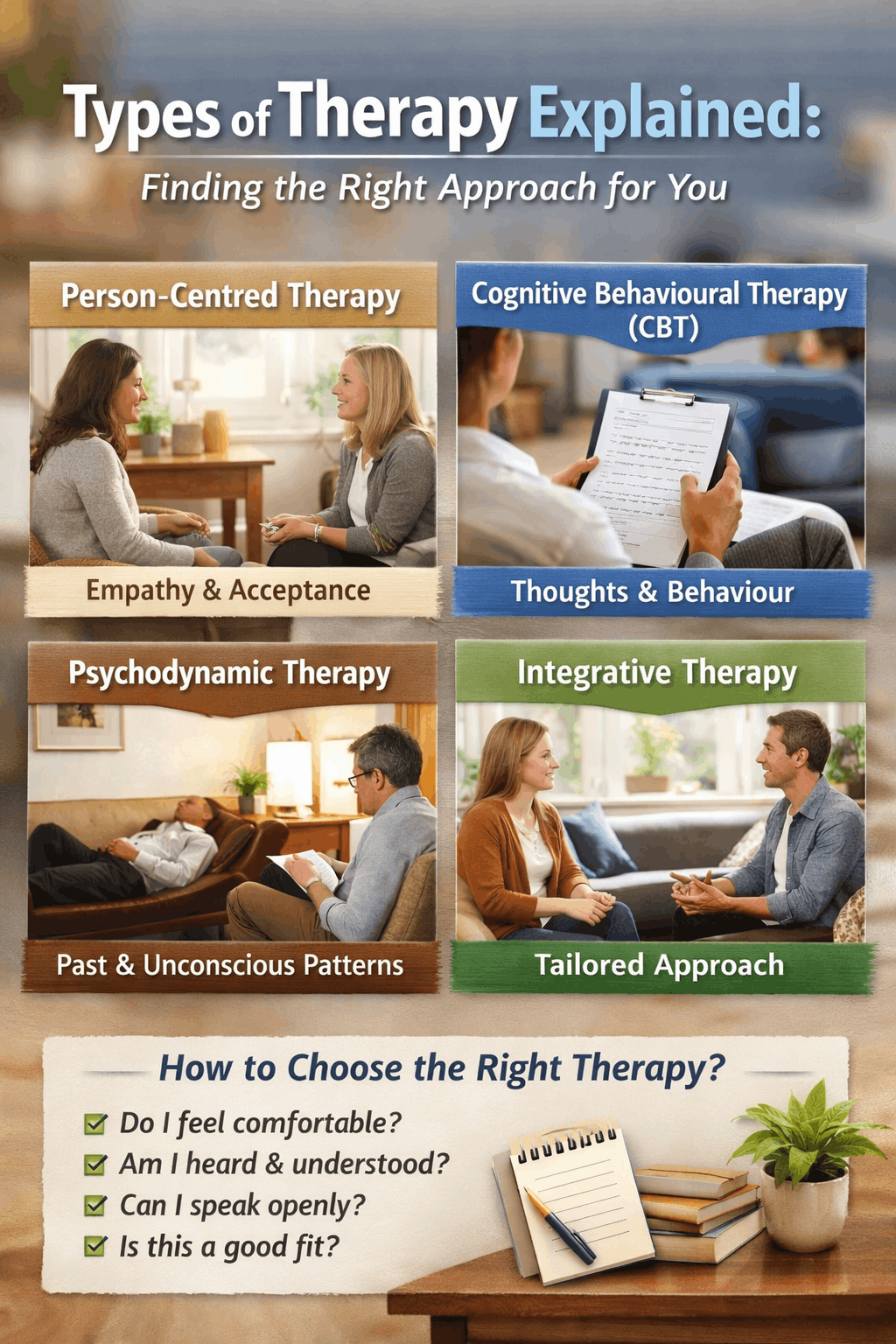
Types of Therapy Explained: Finding the Right Approach for You
Choosing to start therapy can feel like a big step — and often one of the first questions people ask is:
“What type of therapy do I actually need?”
If you’ve started searching for counselling or psychotherapy, you’ve probably come across terms like CBT, person-centred therapy, psychodynamic therapy, or integrative counselling. It can quickly feel overwhelming.
The truth is, there isn’t one “best” type of therapy. Different approaches suit different people, personalities, and situations. Understanding the main types of therapy can help you feel more confident about finding support that genuinely fits you.
Why Are There Different Types of Therapy?
Therapy has evolved over more than a century as psychologists and counsellors have tried to better understand human experience, emotions, and behaviour.
Some approaches focus on thoughts and behaviours in the present. Others explore past experiences and relationships. Some prioritise practical tools, while others centre on emotional understanding and self-growth.
Most importantly, research consistently shows that the relationship between therapist and client is one of the strongest predictors of positive outcomes, regardless of approach.
Still, knowing the differences can help you decide where to begin.
Person-Centred Therapy
Person-centred therapy, developed by Carl Rogers, is based on a simple but powerful belief: people have an innate capacity for growth when given the right conditions. Rather than directing or analysing you, a person-centred counsellor focuses on creating a safe, accepting, and non-judgemental space where you can explore whatever feels important.
Key features include:
-
Empathy and deep listening
-
Authentic, genuine connection
-
Acceptance without judgement
-
Working at your pace
This approach can be particularly helpful if you:
-
Feel overwhelmed or stuck
-
Want to understand yourself better
-
Struggle with self-criticism or low self-esteem
-
Need space to talk openly without pressure
Many people find person-centred therapy empowering because it trusts your own insight and experience.
Cognitive Behavioural Therapy (CBT)
Cognitive Behavioural Therapy (CBT) focuses on the connection between thoughts, feelings, and behaviours. The idea behind CBT is that unhelpful thinking patterns can influence emotional distress. By identifying and challenging these patterns, people can develop healthier responses.
CBT often includes:
-
Goal-focused sessions
-
Practical exercises
-
Thought tracking
-
Behavioural strategies between sessions
It is commonly used for:
-
Anxiety disorders
-
Depression
-
Phobias
-
Panic attacks
-
OCD
Some people appreciate CBT’s structured and practical nature, while others prefer a more exploratory or relational approach.
Psychodynamic Therapy
Psychodynamic therapy explores how past experiences and unconscious patterns influence present thoughts, emotions, and relationships.
This approach developed from early psychoanalytic ideas and focuses on recognising recurring emotional themes or relational patterns.
Sessions may explore:
-
Childhood experiences
-
Attachment and relationships
-
Emotional patterns that repeat over time
-
Unconscious influences on behaviour
Psychodynamic therapy can be helpful for people wanting deeper insight into long-standing difficulties or relationship challenges.
Integrative Therapy
Integrative therapists draw from multiple therapeutic approaches rather than working from a single model. This means therapy can adapt to your needs rather than fitting you into one framework. An integrative therapist might combine:
-
Person-centred understanding
-
CBT techniques
-
Attachment theory
-
Emotional or relational exploration
Many modern therapists work integratively because people and problems rarely fit neatly into one category.
Humanistic and Experiential Therapies
Humanistic therapies — including Gestalt therapy and existential therapy — focus on lived experience, meaning, and personal responsibility.
These approaches often explore questions such as:
-
Who am I becoming?
-
What matters to me?
-
How do I want to live?
They can be particularly valuable during life transitions, identity exploration, or periods of change.
Online Therapy vs In-Person Therapy
Alongside therapeutic approaches, you may also wonder whether therapy should happen online or face-to-face.
Both can be effective.
Online therapy offers:
-
Flexibility
-
Accessibility
-
Comfort of familiar surroundings
In-person therapy offers:
-
Shared physical space
-
Fewer distractions
-
A dedicated environment away from daily life
The best option is usually the one that feels most comfortable and sustainable for you.
How Do You Choose the Right Therapy?
Rather than focusing only on modality, it can help to ask:
-
Do I feel comfortable with this therapist?
-
Do I feel heard and understood?
-
Can I speak openly here?
-
Does the pace feel right for me?
Many people discover that the therapeutic relationship matters more than the label attached to the therapy.
It’s also completely okay to try an initial session and decide whether it feels like a good fit.
A Gentle Reminder
Starting therapy doesn’t mean something is “wrong” with you.
People come to therapy for many reasons:
-
Anxiety or stress
-
Relationship difficulties
-
Burnout or overwhelm
-
Neurodivergence exploration
-
Life transitions
-
Self-understanding and personal growth
Therapy can simply be a space to pause, reflect, and make sense of your experience with someone alongside you.
Final Thoughts
There are many types of therapy available, each offering a different path toward understanding and change. What matters most is finding an approach — and a therapist — where you feel safe enough to be yourself.
If you’re considering therapy, curiosity is a good place to start. You don’t need to have everything figured out before reaching out.
Sometimes the hardest step is simply beginning.
Related reading
More from the blog
Need Support?
If you're ready to take the next step, we're here to help