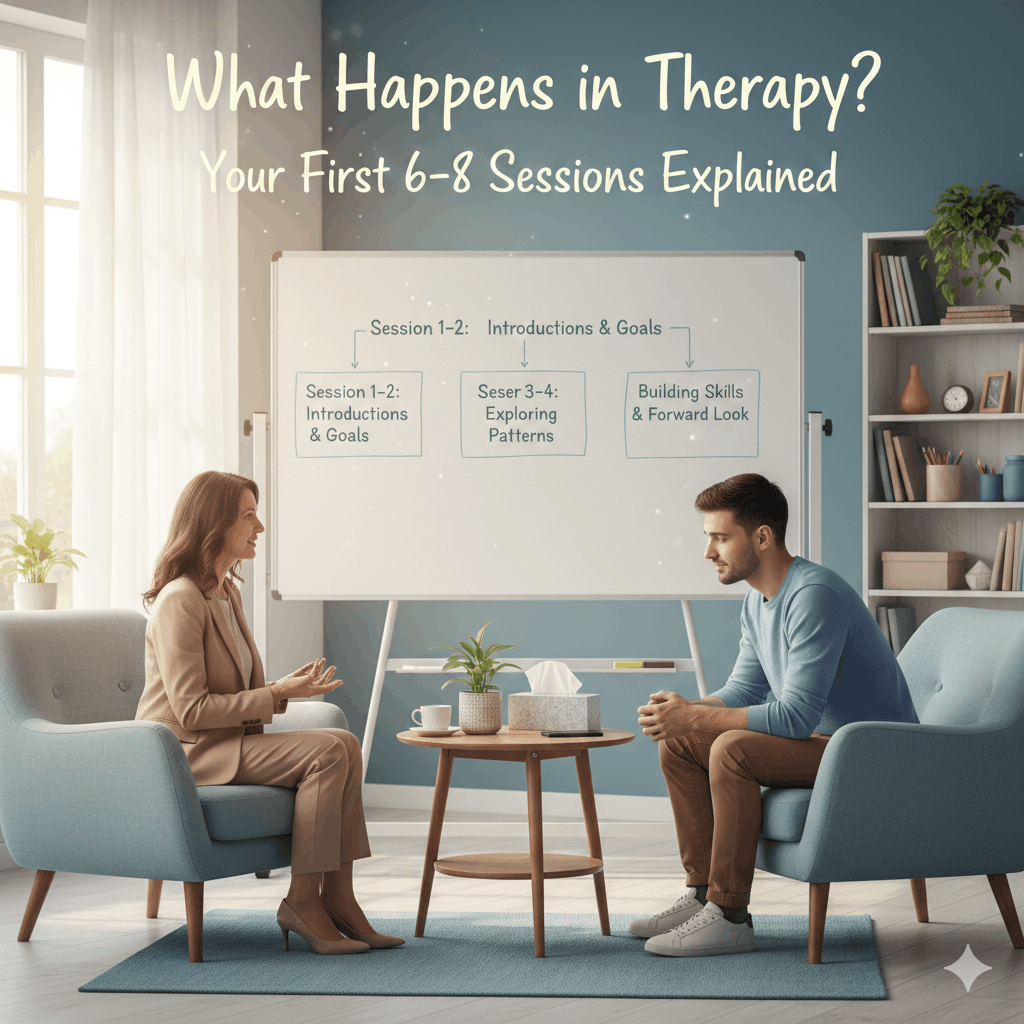
What Happens in Therapy? Your First 6–8 Sessions Explained
Starting therapy can feel like a big step. Even if you know something isn’t quite right, you might still find yourself wondering: What actually happens in therapy? What am I supposed to say? And how long before anything changes?
These questions are incredibly common — especially if you’re dealing with anxiety, overthinking, or feeling emotionally stuck. This guide walks you through what the first 6–8 therapy sessions often look like, so you can approach the process with a bit more clarity and less uncertainty.
Before Your First Session: What Most People Are Feeling
Many people arrive at therapy feeling:
-
Nervous or unsure what to say
-
Worried they’ll “do it wrong”
-
Afraid they’ll be judged or analysed
-
Unsure whether their problems are “bad enough”
None of these feelings mean you’re not ready for therapy — they usually mean the opposite. Therapy isn’t about having the perfect words; it’s about having a space where you don’t need them straight away.
Session 1: Getting Started (Not Fixing Everything)
The first session is mostly about meeting each other and beginning to understand what’s brought you to therapy.
You might talk about:
-
What prompted you to seek support now
-
A bit of your background or recent experiences
-
What you’re hoping therapy might help with
-
Any concerns you have about the process itself
There’s no pressure to go deep immediately. Some people talk a lot; others find it harder to open up at first. Both are completely okay.
This session is less about “solutions” and more about creating a sense of safety, trust, and pace that feels right for you.
Sessions 2–3: Telling Your Story at Your Own Pace
In the next few sessions, therapy often becomes a space where your experiences start to take shape.
You may begin to:
-
Share more detail about ongoing difficulties
-
Notice repeating patterns in thoughts or relationships
-
Explore emotions that don’t always make sense yet
-
Realise how much you’ve been holding together on your own
Many people feel relief during this stage — but it’s also common to feel tired or emotionally tender afterwards. Therapy can bring awareness to things you’ve been coping with quietly for a long time.
Importantly, you’re still not expected to know what the answer is. Therapy is a collaborative process, not an interrogation.
Sessions 4–5: Noticing Patterns and Emotional Themes
By this point, therapy often starts to feel more familiar. You may notice certain themes emerging, such as:
-
Anxiety showing up in specific situations
-
Overthinking as a way of staying in control
-
Strong inner criticism or pressure to “do better”
-
Emotional shutdown or numbness
This stage isn’t about labelling or diagnosing you. It’s about gently understanding how you experience the world — emotionally, mentally, and relationally.
For some people, this is when therapy begins to feel meaningful. For others, it can feel unsettling as deeper awareness develops. Both responses are valid.
Sessions 6–8: Subtle Shifts (Not Sudden Transformations)
One of the biggest myths about therapy is that change happens suddenly. In reality, progress is often quiet and gradual.
You might start to notice:
-
More awareness of your emotions as they arise
-
A little more space between thoughts and reactions
-
Less self-criticism, or quicker self-repair
-
Feeling slightly more grounded or clear
These shifts can be easy to dismiss — but they’re often signs that something important is happening internally.
Therapy isn’t about becoming a different person. It’s about becoming more you, with greater understanding and compassion.
What Therapy Is Not
It can help to know what therapy usually isn’t:
-
A place where you’re told what to do
-
A quick fix or checklist of coping hacks
-
Endless talking without purpose
-
Being judged, diagnosed, or analysed
Good therapy adapts to you. It moves at a pace that feels manageable and respects your autonomy.
How Do You Know If Therapy Is Helping?
Progress in therapy doesn’t always look like “feeling happy.” Instead, it might look like:
-
Feeling more honest with yourself
-
Understanding your reactions more clearly
-
Feeling less alone with difficult emotions
-
Responding differently in moments that used to overwhelm you
If you ever feel unsure, it’s okay to talk about that in therapy itself. Open conversations about how the work is going are part of the process.
Starting Therapy in Falmouth or Cornwall
If you’re considering therapy in Falmouth or the wider Cornwall area, it’s worth remembering that therapy is not about being in crisis — it’s about support, understanding, and change over time.
Taking the first step often feels like the hardest part. The sessions that follow tend to unfold more naturally than people expect.
A Final Thought
Therapy isn’t about having the “right” problem or the “right” words. It’s about showing up as you are and allowing space for things to make sense at their own pace.
If you’re feeling unsure, anxious, or stuck in overthinking, that uncertainty is often a good enough place to begin.
Related reading
More from the blog
Need Support?
If you're ready to take the next step, we're here to help