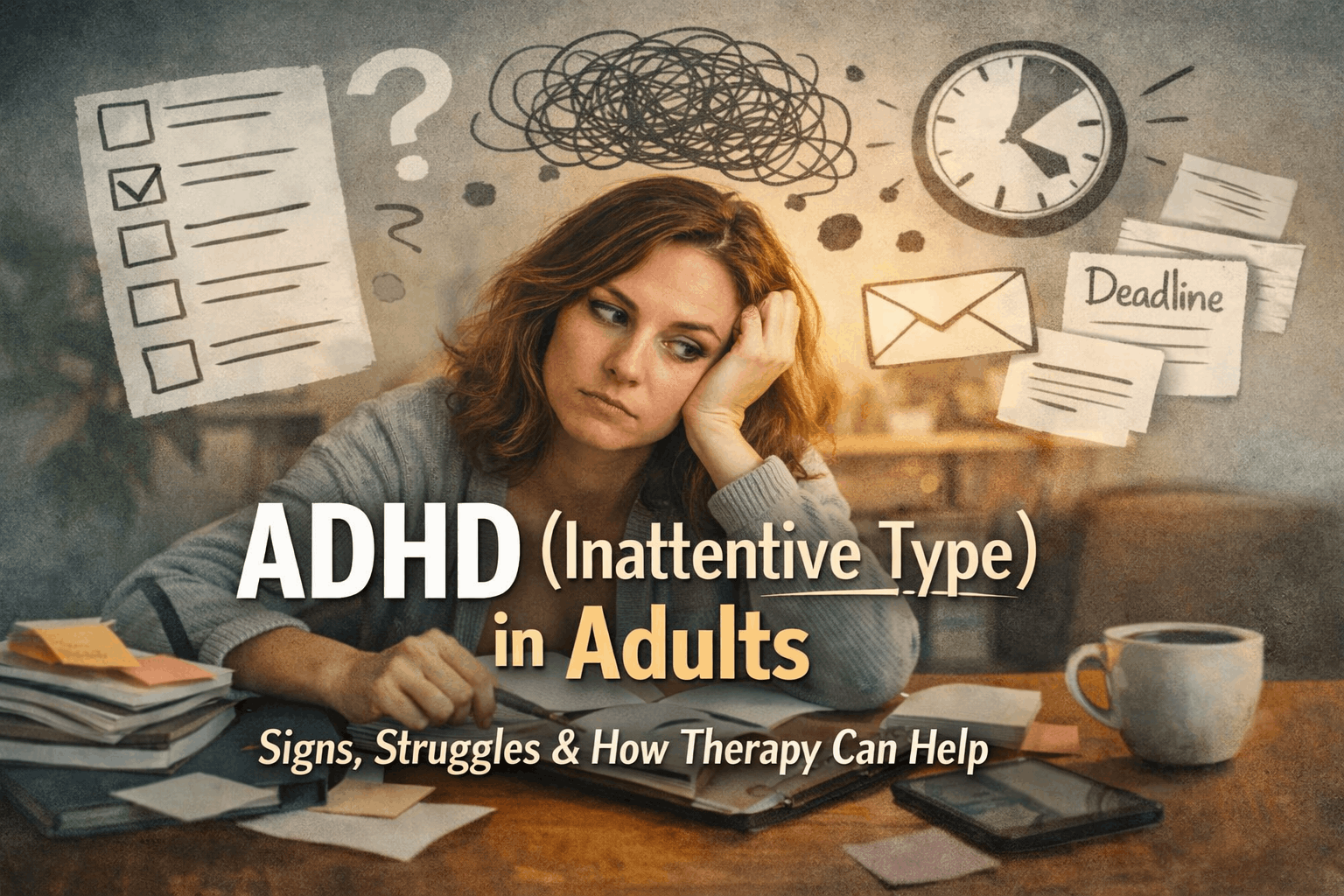
ADHD (Inattentive Type) in Adults: Signs, Struggles, and How Therapy Can Help
ADHD Isn’t Always What You Think
When people hear “ADHD,” they often picture someone who is restless, impulsive, or unable to sit still.
But for many adults, ADHD looks very different.
Inattentive ADHD is quieter. It often shows up as:
- Struggling to focus
- Feeling mentally overwhelmed
- Forgetting things easily
- Starting tasks but not finishing them
Because it’s less obvious, many people go years—sometimes decades—without realising what’s going on.
Instead, they may describe themselves as:
- “lazy”
- “bad at life admin”
- “constantly behind”
- “just an overthinker”
If that resonates, you’re not alone—and there may be a clearer explanation.
What Is Inattentive ADHD?
ADHD (Attention Deficit Hyperactivity Disorder) has different presentations. The inattentive type doesn’t involve obvious hyperactivity—it’s more about how attention, organisation, and mental energy work.
Common signs in adults include:
- Difficulty sustaining attention (especially on boring or complex tasks)
- Frequently losing things (keys, phone, emails, thoughts)
- Zoning out in conversations
- Procrastination that feels hard to control
- Struggling with structure and routine
- Feeling overwhelmed by simple tasks
It’s not about intelligence or effort.
In fact, many people with inattentive ADHD are thoughtful, capable, and self-aware—but feel like they can’t consistently “translate” that into action.
Why It Often Gets Missed
Inattentive ADHD is easy to overlook—especially in adults.
You might have:
- Done “well enough” at school
- Learned to mask or compensate
- Been labelled as anxious or disorganised instead
Over time, this can lead to a quiet build-up of frustration:
“Why does everything feel harder for me than it should?”
Because the struggles are internal, people often blame themselves rather than consider ADHD.
ADHD vs Anxiety: Why They Often Overlap
A lot of people who explore ADHD first come to therapy for anxiety.
That’s because inattentive ADHD can create constant low-level stress:
- Forgetting things → worry about consequences
- Falling behind → pressure and guilt
- Overwhelm → avoidance → more stress
This can look like:
- Overthinking
- Difficulty relaxing
- Feeling mentally “busy” all the time
In some cases, anxiety develops as a response to unmanaged ADHD—not the root cause.
Understanding this can be a huge relief.
The Emotional Impact (That Often Gets Overlooked)
ADHD isn’t just about focus—it can deeply affect how you feel about yourself.
Many adults carry:
- Chronic self-doubt
- Shame around productivity
- Fear of letting people down
- A sense of not reaching their potential
You might recognise thoughts like:
- “I should be able to do this”
- “Everyone else seems to manage”
- “I just need to try harder”
Over time, this can impact confidence, relationships, and overall wellbeing.
What Therapy Can Help With
Therapy for ADHD isn’t about “fixing” you—it’s about understanding how your mind works and finding ways to work with it.
In a person-centred approach, we might explore:
- How your attention and motivation actually function
- The patterns behind procrastination or avoidance
- The emotional impact of years of feeling “not good enough”
- Ways to reduce overwhelm and build realistic structure
It’s less about strict systems—and more about self-understanding and compassion.
Practical Areas We Might Explore
While therapy isn’t purely practical coaching, it can still support areas like:
1. Managing overwhelm
Breaking tasks into manageable steps and reducing the “freeze” response.
2. Understanding your focus patterns
Noticing when your brain works with you vs against you.
3. Reducing self-criticism
Shifting away from blame and towards understanding.
4. Building sustainable routines
Not rigid systems—but flexible approaches that actually fit your life.
Do You Need a Diagnosis First?
Not necessarily.
Some people come to therapy:
- Already diagnosed
- Exploring whether ADHD fits
- Or simply noticing these patterns and wanting support
Therapy can be helpful at any stage.
If you do want a diagnosis, we can talk through options—but you don’t need one to start making sense of your experience.
ADHD in Adults: A Different Way of Understanding Yourself
For many people, recognising inattentive ADHD is a turning point.
Not because it labels you—but because it explains things that never quite made sense before.
It can shift the narrative from:
- “What’s wrong with me?”
to - “This is how my brain works—and I can learn to work with it.”
Looking for ADHD Support in Falmouth or Cornwall?
If you’re based in Falmouth or Cornwall and some of this feels familiar, therapy can offer a space to explore it without judgement.
You don’t need to have everything figured out.
Sometimes, it starts with a simple conversation.
Related reading
More from the blog
Need Support?
If you're ready to take the next step, we're here to help