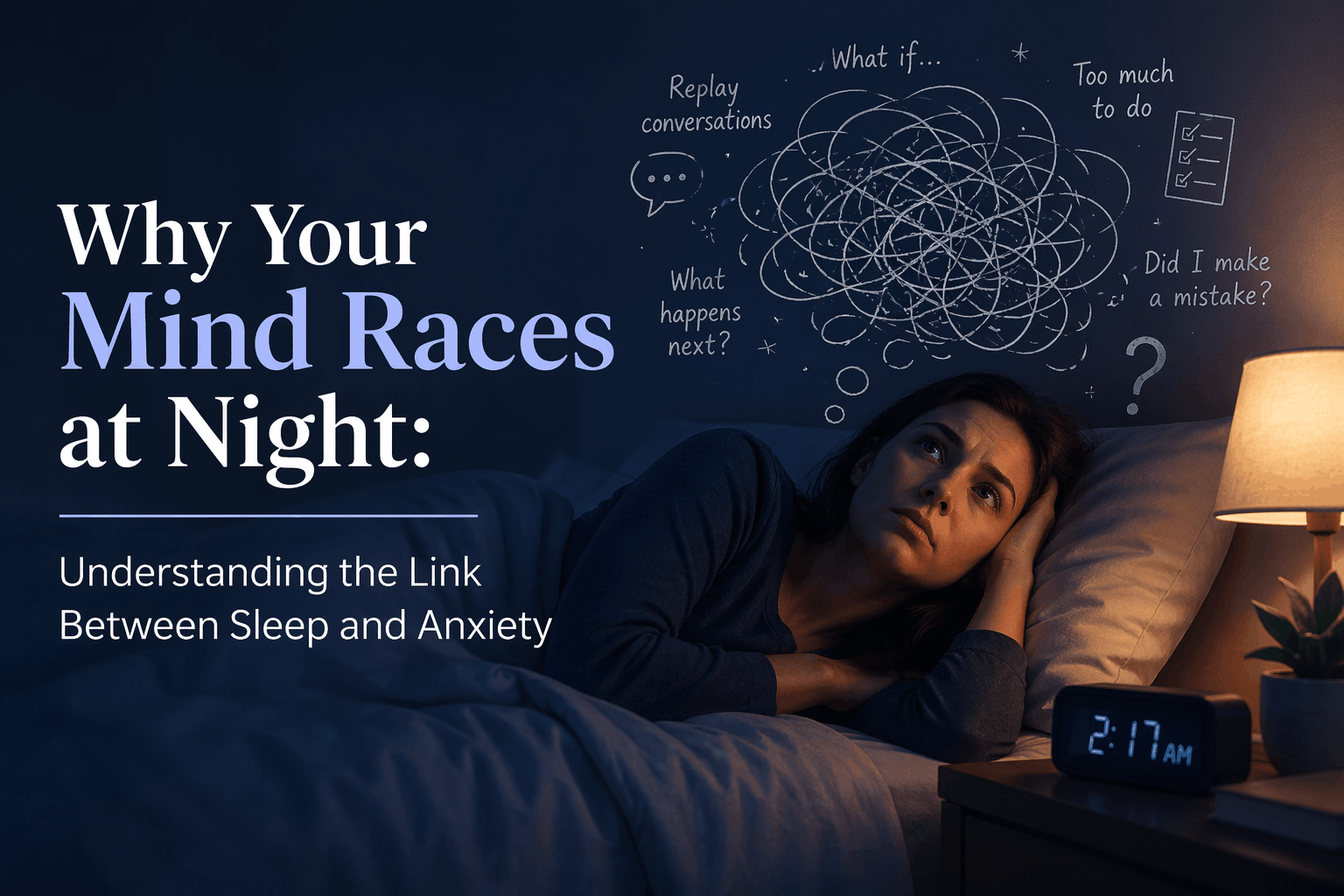
Why Your Mind Races at Night: Understanding the Link Between Sleep and Anxiety
You've had a full day. You're genuinely tired. You get into bed, turn off the light, and then — as if on cue — your brain wakes up. Tomorrow's meeting. That thing you said three weeks ago. A noise downstairs. The mortgage. Whether you locked the back door. A conversation from 2014 that, for some reason, has chosen tonight to resurface.
If this is a familiar pattern, you're not alone, and you're not doing anything wrong. The relationship between sleep and anxiety is one of the most common, and most frustrating, loops that brings people to therapy. It's also one that can quietly erode your quality of life long before you think of it as a "real" problem worth addressing.
Why Anxiety and Sleep Are So Tightly Linked
Anxiety is, at its core, a state of heightened alertness. Your nervous system is doing its job — scanning for threat, preparing you to respond, keeping you ready. That's useful when there's an actual lion in the grass. It's considerably less useful at 11:47pm when you're trying to drift off and your nervous system has decided that your inbox is the lion.
Sleep requires the opposite state. To fall asleep, your body needs to downshift: heart rate slows, breathing deepens, the thinking parts of the brain quieten down, and the system as a whole lowers its guard. Anxiety keeps the guard up. That's the fundamental conflict.
What makes it worse is that poor sleep then feeds anxiety the next day. A tired brain is less able to regulate emotion, less able to put worries into perspective, and more likely to interpret neutral events as threatening. So you go into the next evening already more wound up than you were the night before — and the cycle tightens.
The Shapes Sleep Anxiety Takes
Sleep-related anxiety doesn't look the same for everyone. Some of the most common patterns include:
The racing mind at bedtime. You feel tired until the moment your head hits the pillow, at which point your brain launches into a review of the day, a preview of tomorrow, or a tour of your long-term worries.
The 3am wake-up. You fall asleep fine, but wake in the early hours with your heart already pounding and your thoughts already running. Getting back to sleep feels impossible.
Anticipatory dread. You start worrying about sleep in the early evening — or even the day before — which of course makes sleep less likely, which confirms the worry, which reinforces the dread.
The body that won't settle. Less about thoughts, more about physical restlessness: tense muscles, a jumpy feeling, the sense that something is "on" that you can't switch off.
Performance anxiety about sleep itself. The more you need to sleep (because you're exhausted, or because tomorrow matters), the harder it becomes. Trying to sleep is, cruelly, one of the least effective ways to actually sleep.
Why "Just Relax" Doesn't Work
If you've been struggling with this for a while, you've probably been told to put your phone away an hour before bed, have a warm bath, avoid caffeine after midday, and try some deep breathing. These things aren't wrong. For a lot of people, though, they don't touch the actual problem.
The reason is that sleep anxiety is rarely just about sleep. It's usually a symptom of something broader: unprocessed stress, an overloaded nervous system, perfectionism, a life that doesn't have enough pauses in it, or anxiety that hasn't had anywhere else to go during the day. The bedroom becomes the place where all of that finally catches up with you, because it's the first time in 16 hours you've stopped moving.
That's why sleep hygiene alone often falls short. You can dim the lights and drink chamomile tea all you like — if your nervous system is running at a level 8 all day, it won't drop to a 2 just because you've put the phone in another room.
How Therapy Can Help
Therapy approaches sleep anxiety differently from a sleep clinic. Rather than focusing only on behaviours around bedtime, a therapist will usually want to understand the wider picture: what your days look like, what you're carrying that you haven't had space to process, where your anxiety is rooted, and what role sleep has started to play in that system.
Some of the things that often come up in this work include:
Learning to recognise what your nervous system is actually doing, rather than fighting with your thoughts. Many people are surprised to discover that their "anxious thinking" at night is downstream of a body that's been in low-grade fight-or-flight for hours.
Looking at what the day isn't allowing you to feel or notice — because whatever gets squeezed out of the day tends to turn up at night.
Working with the specific thought patterns that keep you up: catastrophising, rumination, the "one more check" loop, or the trap of trying to solve tomorrow's problems tonight.
Unpicking the relationship you've developed with sleep itself. If you've been sleeping badly for months or years, sleep can become something you approach with dread rather than ease, and that association needs gentle undoing.
Approaches like CBT (including CBT-I, specifically for insomnia), along with more relational and body-based therapies, can all be useful here. The right approach depends on what's underneath your sleep difficulties, which is something worth exploring with a therapist rather than guessing at alone.
When to Consider Reaching Out
Occasional bad nights are part of being human. But if sleep anxiety has become a regular feature of your week, if you're dreading bedtime, if tiredness is affecting your work or relationships, or if you've been quietly struggling with this for months and hoping it will pass — that's a reasonable point to get some support.
You don't need to wait until it's unbearable. One of the most common things people say in early sessions is that they wish they'd come sooner. Sleep touches everything: mood, focus, patience, physical health, the way you show up for the people around you. Taking it seriously isn't indulgent — it's practical.
If you're in Falmouth or the wider Cornwall area and sleep anxiety is wearing you down, therapy can offer a space to understand what's really going on and find a way through it that goes deeper than another list of bedtime tips.
Related reading
More from the blog
Need Support?
If you're ready to take the next step, we're here to help