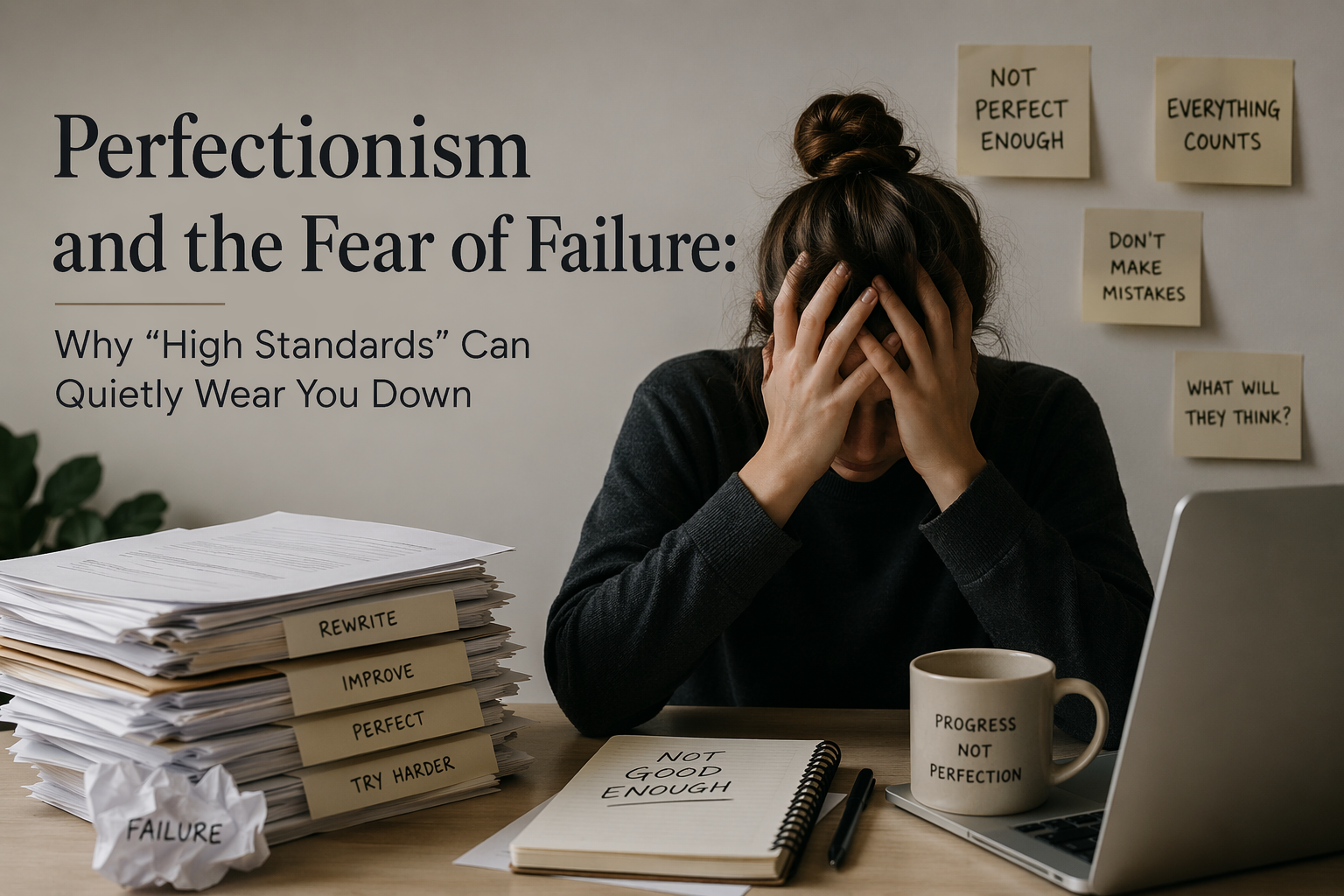
Perfectionism and the Fear of Failure: Why "High Standards" Can Quietly Wear You Down
From the outside, perfectionism often looks like a good thing. You're the reliable one. The person who double-checks the email before sending. The colleague who stays late to polish the report. The parent who wants to get it right. The friend who agonises over the perfect birthday message.
But underneath the competence and the care, perfectionism often tells a different story — one of quiet exhaustion, self-criticism, and a constant low hum of anxiety. If you've ever finished something genuinely well and still felt hollow rather than proud, or if you've avoided starting something because you couldn't guarantee doing it brilliantly, you already know the feeling.
Perfectionism isn't really about high standards. It's often the fear of failure wearing a more socially acceptable disguise.
The difference between striving and perfectionism
Healthy striving and perfectionism can look similar on the surface, but they feel very different from the inside.
Healthy striving is motivated by growth. You set a goal, you work towards it, you make mistakes, you learn, and your sense of self isn't on the line. Even when things don't go to plan, you can recover without it feeling catastrophic.
Perfectionism is motivated by fear. The goal isn't to do well — it's to avoid the feeling of having failed, of being judged, of being exposed as "not enough." Mistakes aren't learning opportunities; they feel like evidence. Your self-worth becomes tied to the outcome, which means every task, however small, carries hidden weight.
This is why perfectionists often describe feeling tired in a way that rest doesn't fix. It's not the work that's exhausting — it's the constant internal monitoring.
How perfectionism actually shows up
Perfectionism isn't always the stereotype of the straight-A student or the immaculate house. It's often subtler, and it takes many forms:
- Procrastination. If you can't be sure you'll do it perfectly, starting feels unbearable — so you don't. Then you feel guilty, which confirms the story that you're failing.
- Over-preparation. You spend hours on something that should take thirty minutes because you can't bring yourself to submit, send, or share until it's "right."
- Harsh self-talk. An inner voice that would be considered cruel if it came from anyone else, but which you've normalised as "just being hard on yourself."
- Difficulty celebrating. You finish something and immediately move the goalposts. What felt important yesterday now feels like the bare minimum.
- All-or-nothing thinking. If you can't do it properly, you'd rather not do it at all. This is why perfectionists often struggle with exercise, hobbies, or habits they say they want.
- People-pleasing. Being liked, needed, or approved of becomes another area where "failure" feels unsafe.
- Physical symptoms. Tension headaches, disturbed sleep, a tight chest, or digestive issues that flare when you're under pressure.
Many people who come to therapy for anxiety, burnout, or low mood discover that perfectionism has been quietly fuelling the problem for years.
Where it comes from
Perfectionism rarely comes from nowhere. It's usually a strategy — one you developed, often in childhood, to stay safe, loved, or in control in an environment where those things felt uncertain.
Maybe praise in your family was conditional on achievement. Maybe mistakes were met with criticism, disappointment, or withdrawal. Maybe you were the "easy" child who learned that being good meant not being a burden. Maybe school taught you that your worth was measured in grades, and you've never quite updated the software.
For some people, perfectionism is linked to neurodivergence — ADHD or autism can both involve a painful gap between what you know you're capable of and what you actually manage on a given day, and perfectionism can develop as an attempt to close that gap through sheer effort.
None of this is your fault. And understanding where the pattern began is often the first step to loosening its grip.
Why willpower alone rarely works
If you've tried to "just relax" or "stop being so hard on yourself," you'll know it doesn't work. That's not a personal failing — it's because perfectionism isn't really a thinking problem. It's a feeling problem dressed up as a thinking problem.
The underlying feeling is usually some version of: if I fail, something bad will happen. I'll be rejected. I'll be exposed. I'll feel that unbearable feeling I've been avoiding my whole life.
You can't out-logic that. Telling yourself "it doesn't matter if this isn't perfect" doesn't calm the nervous system, because the nervous system isn't responding to the task — it's responding to an older, deeper story about what failure means.
This is why self-help advice about perfectionism often falls flat. You already know you're being hard on yourself. Knowing isn't the problem.
How therapy can help
Therapy offers something different: a space to actually feel, rather than analyse, what sits underneath the pattern. A good therapist won't just help you manage perfectionism — they'll help you understand it, compassionately and without judgment, so it starts to loosen naturally rather than through force.
Depending on your preferences and what's driving things, this might involve:
- CBT approaches to notice and challenge the specific thoughts that fuel perfectionist cycles, and to experiment with doing things "imperfectly" in safe, structured ways.
- Person-centred or psychodynamic work to explore where the pattern came from and what it's been protecting you from.
- Compassion-focused therapy, which is particularly effective for the harsh inner critic that usually sits at the heart of perfectionism.
- Somatic awareness — learning to recognise and tolerate the physical feelings of "not getting it right," so your body stops treating every task like a threat.
Most of the people I work with find that the goal isn't to lower their standards. It's to take their self-worth off the table, so they can do good work without it costing so much.
You don't have to earn the right to rest
If you're reading this and recognising yourself, it's worth saying clearly: you don't have to keep living like this. The relentlessness isn't a personality trait. It's a pattern, and patterns can change.
If you'd like to talk about working together, I offer in-person counselling in Falmouth and online sessions across Cornwall. You're welcome to get in touch for a free initial conversation — no pressure, and no need to have it all figured out before you reach out.
Sometimes the first imperfect thing you do is the most important.
Related reading
More from the blog
Need Support?
If you're ready to take the next step, we're here to help