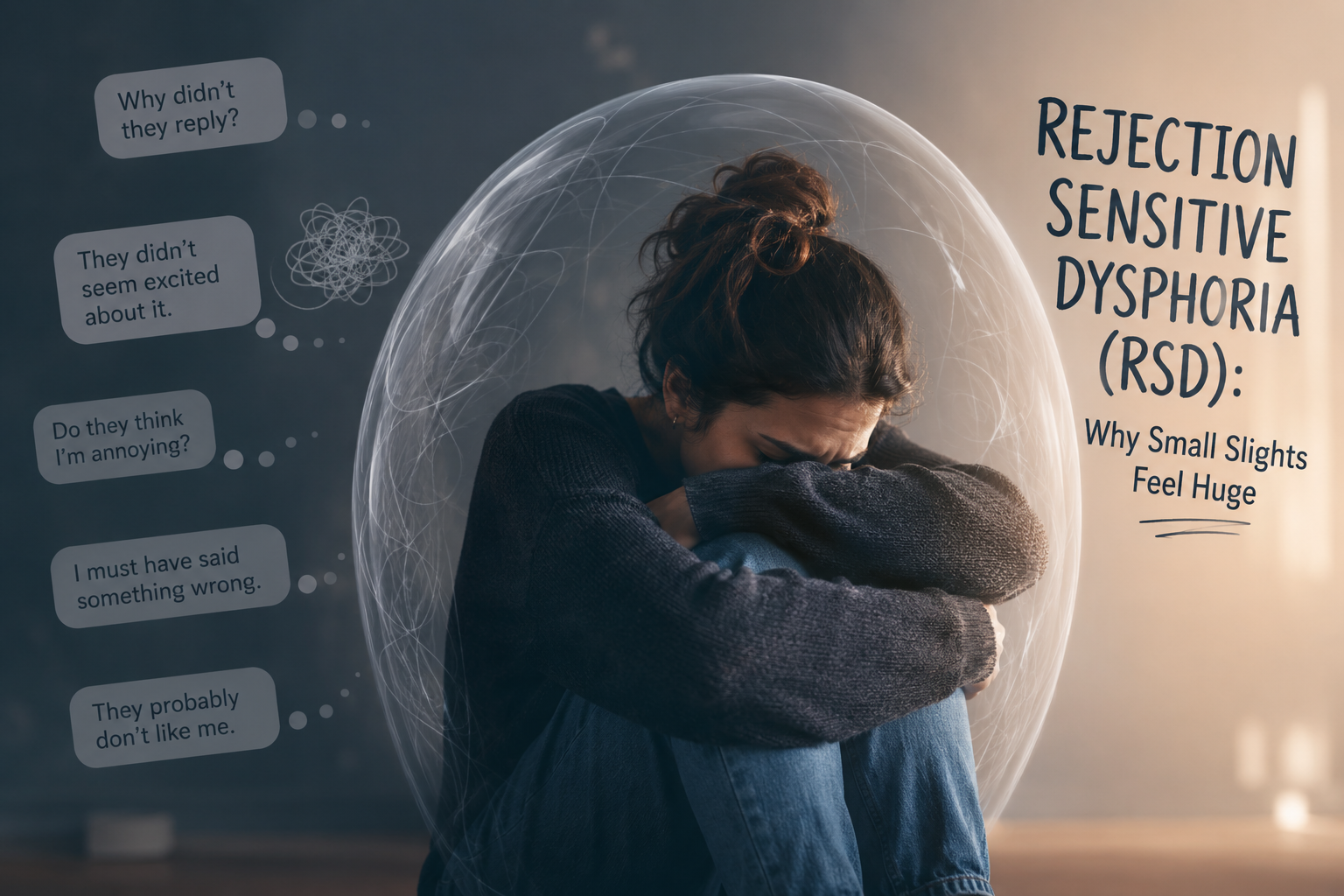
Rejection Sensitive Dysphoria (RSD): Why Small Slights Feel Huge
A friend takes a few hours longer than usual to reply to your message. A colleague gives you slightly clipped feedback in a meeting. Your partner sighs when you ask what's for dinner. To most people, these are forgettable moments. To you, they hit like a punch to the chest — and the rest of the day is spent replaying them, convinced you've done something wrong.
If that sounds familiar, you might be experiencing something called Rejection Sensitive Dysphoria, or RSD. It's not officially listed as a diagnosis, but it's a term used widely by clinicians and researchers to describe an intense, often overwhelming emotional response to rejection — whether that rejection is real, perceived, or simply imagined.
In this post, we'll look at what RSD actually is, why it's so closely linked to ADHD, how it shows up in everyday life, and what kind of support is available if you're based in Falmouth or anywhere across Cornwall.
What is Rejection Sensitive Dysphoria?
The word "dysphoria" comes from Greek and roughly translates as "unbearable." That gives you a sense of just how intense RSD can feel. It's not the ordinary disappointment we all experience when something doesn't go our way — it's a sudden, almost physical wave of shame, hurt, or anger that can be hard to control and even harder to explain to people who don't experience it.
People with RSD often describe it as feeling like:
- A sudden plunge in mood after a small social interaction
- Physical pain or tightness in the chest after perceived criticism
- A flash of anger or tears that comes out of nowhere
- An urge to withdraw, hide, or end relationships pre-emptively
- Hours or days of rumination over something that lasted seconds
The tricky part is that the trigger doesn't have to be real. A neutral facial expression, a delayed reply, or a slight change in tone can be enough to set the whole cycle off.
Why is RSD so often linked to ADHD?
RSD is most commonly discussed in the context of ADHD, particularly in adults. Researchers believe this connection comes down to differences in how the ADHD brain processes emotion — specifically, difficulties with emotional regulation, which is now recognised as a core part of ADHD rather than an optional extra.
For someone with ADHD, emotions can arrive faster, hit harder, and take longer to settle. Rejection — or the suggestion of it — can flood the system before the rational, problem-solving part of the brain has a chance to weigh in. By the time you've thought "wait, they probably didn't mean it like that," the damage is already done.
It's also worth noting that many adults with ADHD have spent years receiving subtle (or not-so-subtle) criticism: for being too much, too forgetful, too sensitive, too disorganised. By adulthood, the nervous system can be primed to expect rejection, which makes even neutral interactions feel loaded.
RSD isn't exclusive to ADHD, though. People who are autistic, who experienced childhood emotional neglect, or who grew up in critical or unpredictable environments can also experience strong rejection sensitivity.
How RSD shows up in everyday life
RSD doesn't always look the way you'd expect. Some of the most common patterns include:
Perfectionism and overworking. If criticism feels unbearable, the logical solution is to never give anyone a reason to criticise you. This can look like over-preparing, double-checking everything, or refusing to delegate.
People-pleasing. Saying yes when you mean no, agreeing with opinions you don't hold, or going to enormous lengths to keep everyone happy — all to avoid the possibility of rejection.
Avoidance. Not applying for the job, not asking the person out, not putting your work forward. If you don't try, you can't be rejected.
Sudden withdrawal. Pulling away from friendships or relationships at the first sign of trouble, sometimes ending things yourself before the other person can.
Anger and defensiveness. RSD doesn't always look like sadness. For some people it shows up as flashes of irritation or anger, particularly toward the person they believe has rejected them.
The result is often exhausting. You're working overtime, emotionally and practically, just to manage the possibility of rejection — and the inner critic rarely takes a day off.
Why "just don't take it personally" doesn't work
Anyone who has experienced RSD will tell you that being told to "not take things so personally" is one of the least helpful pieces of advice imaginable. RSD isn't a thinking problem you can logic your way out of — it's a nervous system response. The feeling arrives before the thought.
That doesn't mean nothing can be done. It just means the work has to happen at a deeper level than surface-level reframing.
How therapy can help
Therapy can be genuinely useful for RSD, particularly when it focuses on emotional regulation, self-compassion, and untangling the older experiences that are often layered into present-day reactions. Depending on what fits, this might include:
- CBT and ACT approaches to notice the thoughts and physical sensations that come with RSD, and to develop a different relationship with them rather than fighting them
- Compassion-focused therapy, which helps soften the inner critic that often runs alongside rejection sensitivity
- Working with the underlying ADHD or neurodivergence, so that RSD is understood in context rather than treated as a personal flaw
- Exploring earlier experiences that may have shaped how your nervous system responds to perceived rejection now
Therapy isn't about turning you into someone who doesn't care what others think. It's about giving you a bit more space between the trigger and the reaction — enough space to choose how you respond, rather than being swept along by it.
Finding support in Falmouth and across Cornwall
If you're based in Falmouth, Truro, Penryn, Helston, or anywhere across Cornwall, support for rejection sensitivity and the conditions it often sits alongside is available locally. Working with a therapist who understands ADHD, neurodivergence, and the way emotional sensitivity actually feels from the inside can make a significant difference — far more than generic advice ever will.
If any of this has resonated with you, you're not being dramatic, and you're not too sensitive. RSD is a real and well-documented experience, and there's genuine support available.
To find out more about therapy in Falmouth, or to book an initial conversation, please get in touch. Sometimes the first step is just having someone take it seriously.
Related reading
More from the blog
Need Support?
If you're ready to take the next step, we're here to help