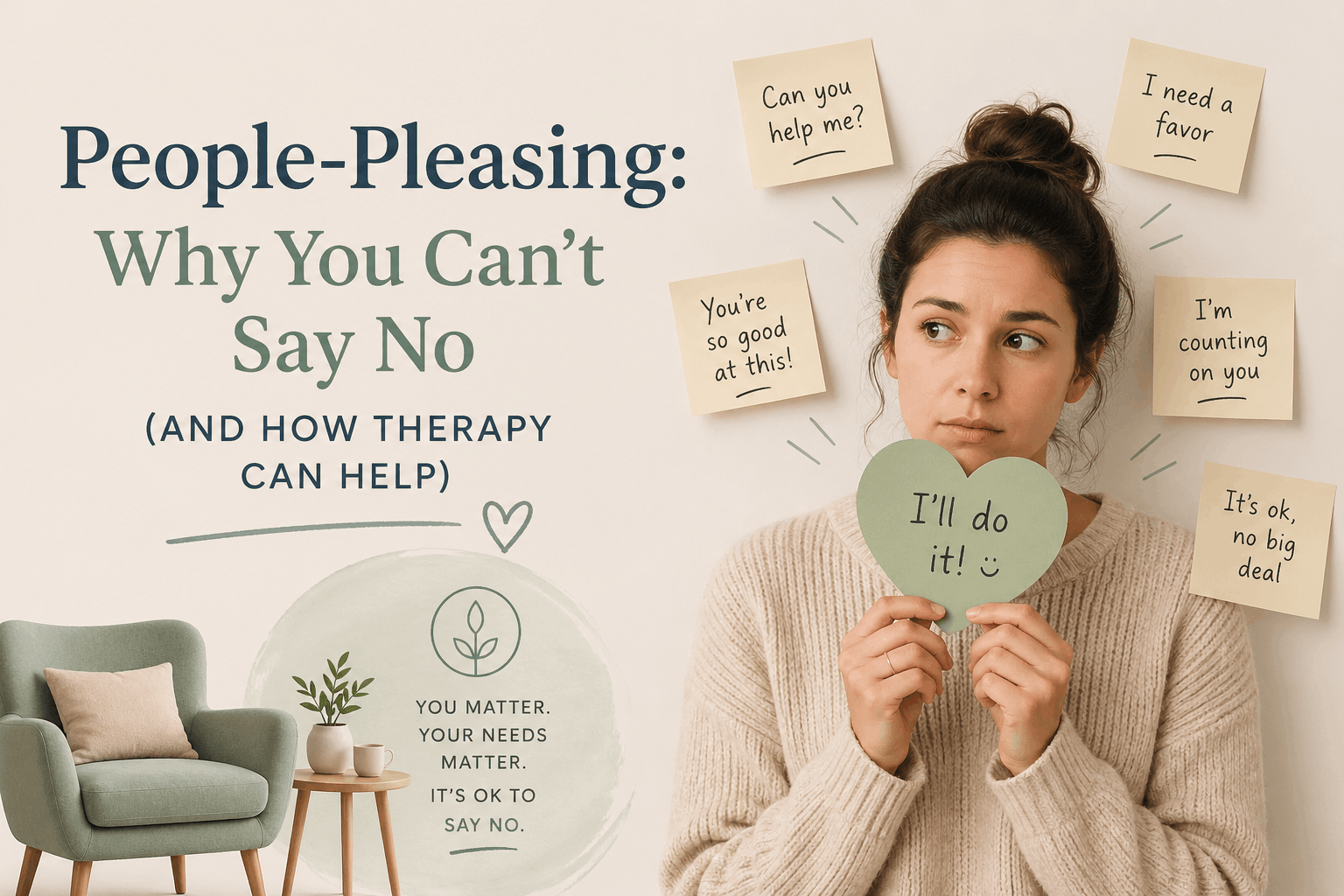
People-Pleasing: Why You Can't Say No (and How Therapy Can Help)
You agree to the extra shift even though you're already drained. You say "no worries" when there are, in fact, worries. You apologise when someone bumps into you in the supermarket. By the end of the week you feel hollowed out, quietly resentful, and unsure why you're so tired when nothing dramatic has actually happened.
If any of that sounds familiar, you may be caught in a pattern of people-pleasing — and you're far from alone. It's one of the most common things that brings people into therapy in Falmouth, even when they don't have a name for it yet.
What Is People-Pleasing, Really?
People-pleasing is more than just being kind or considerate. Genuine kindness comes from a place of choice and capacity. People-pleasing comes from a place of fear — fear of conflict, rejection, disapproval, or being seen as "difficult."
It often looks like:
- Saying yes to things you don't want to do, then resenting it later
- Apologising constantly, even for things that aren't your fault
- Struggling to give honest opinions in case they upset someone
- Feeling responsible for other people's moods and emotions
- Avoiding conflict at almost any cost
- Going quiet or shutting down when someone's unhappy with you
- Feeling guilty for resting, saying no, or putting yourself first
From the outside, it can look like agreeableness. From the inside, it feels like exhaustion.
Where People-Pleasing Comes From
People-pleasing is rarely a personality flaw. It's usually a learned survival strategy — one that made sense at some point in your life.
Many people who struggle with it grew up in environments where love or safety felt conditional. Maybe a parent's mood was unpredictable, and being "good" or "easy" helped keep the peace. Maybe expressing needs was met with criticism, dismissal, or withdrawal. Maybe you were praised for being mature, helpful, or low-maintenance, and learned that your worth came from what you gave to others.
Over time, the nervous system learns: keep others happy, and you stay safe. That wiring doesn't switch off when you become an adult. It just shows up in your relationships, your work, and the quiet ache of always putting yourself last.
The Cost of Always Saying Yes
People-pleasing has a real psychological price tag. The most common consequences include:
Burnout. When you're constantly meeting other people's needs, you run out of fuel for your own life. Many people who come to therapy with burnout discover that people-pleasing is a hidden engine driving it.
Anxiety. Constantly monitoring other people's reactions is exhausting work. The brain stays on high alert, scanning for signs of disapproval — which is why people-pleasing and anxiety so often travel together.
Resentment. You can't keep giving from an empty cup without feeling something about it. Resentment leaks out sideways: snappiness, withdrawal, passive-aggression, or a low-grade sense of being unappreciated.
Loss of identity. When you've spent years shaping yourself around what others want, it can become genuinely hard to answer simple questions like what do I actually want? or what do I enjoy? That disconnection is one of the more painful parts of the pattern.
Relationships that don't quite work. Ironically, people-pleasing often damages the relationships it's trying to protect. Without honesty about your needs, real intimacy can't develop. You end up surrounded by people who know a curated version of you.
Why It's So Hard to Stop
If you've ever tried to "just say no more often," you'll know it's not that simple. The moment you try to set a limit, the discomfort kicks in: guilt, anxiety, intrusive thoughts about whether the other person is angry, urges to over-explain or take it back.
That's because people-pleasing isn't really about the other person. It's about how unsafe disapproval feels in your body. Until that underlying fear is addressed, willpower alone tends not to hold.
This is also where it overlaps with perfectionism and high-functioning anxiety — patterns that share the same root: trying to earn safety, love, or approval through performance.
How Therapy in Falmouth Can Help
Therapy offers something that self-help books and willpower usually can't: a space to actually experience doing things differently, with support.
A therapist can help you:
- Understand the roots. Where did you learn that your needs were less important? Making sense of the pattern often loosens its grip.
- Reconnect with what you want. This sounds simple but is often the hardest part. Many people have spent so long focused outward that their own preferences feel blurry.
- Sit with the discomfort of disappointing people. Not because disappointing people is the goal, but because the fear of it has been running your life. Building tolerance for that discomfort is genuinely freeing.
- Practise honest, kind communication. Saying no, asking for things, naming how you feel — these are skills, and therapy is a good place to rehearse them.
- Address the anxiety underneath. Approaches like CBT, person-centred counselling, or integrative therapy can all help, depending on what fits you. (You can read more about different types of therapy and how talking therapy compares to CBT.)
The goal isn't to become selfish or hard. It's to develop the kind of self-respect that lets your kindness become a choice again, rather than a reflex.
You're Allowed to Take Up Space
One of the quiet revelations of this work is realising that the people who genuinely care about you don't actually want a watered-down, ever-agreeable version of you. They want the real one — opinions, needs, limits, and all.
If you're in Falmouth, Penryn, Truro, or the surrounding areas and you recognise yourself in any of this, you don't have to keep running on empty. Therapy can help you understand the pattern, work with it gently, and start building a life that has room for you in it.
[Get in touch] to book an initial session, or have a look at what to expect from your first few sessions if you're not sure what therapy actually involves.
Related reading
More from the blog
Need Support?
If you're ready to take the next step, we're here to help