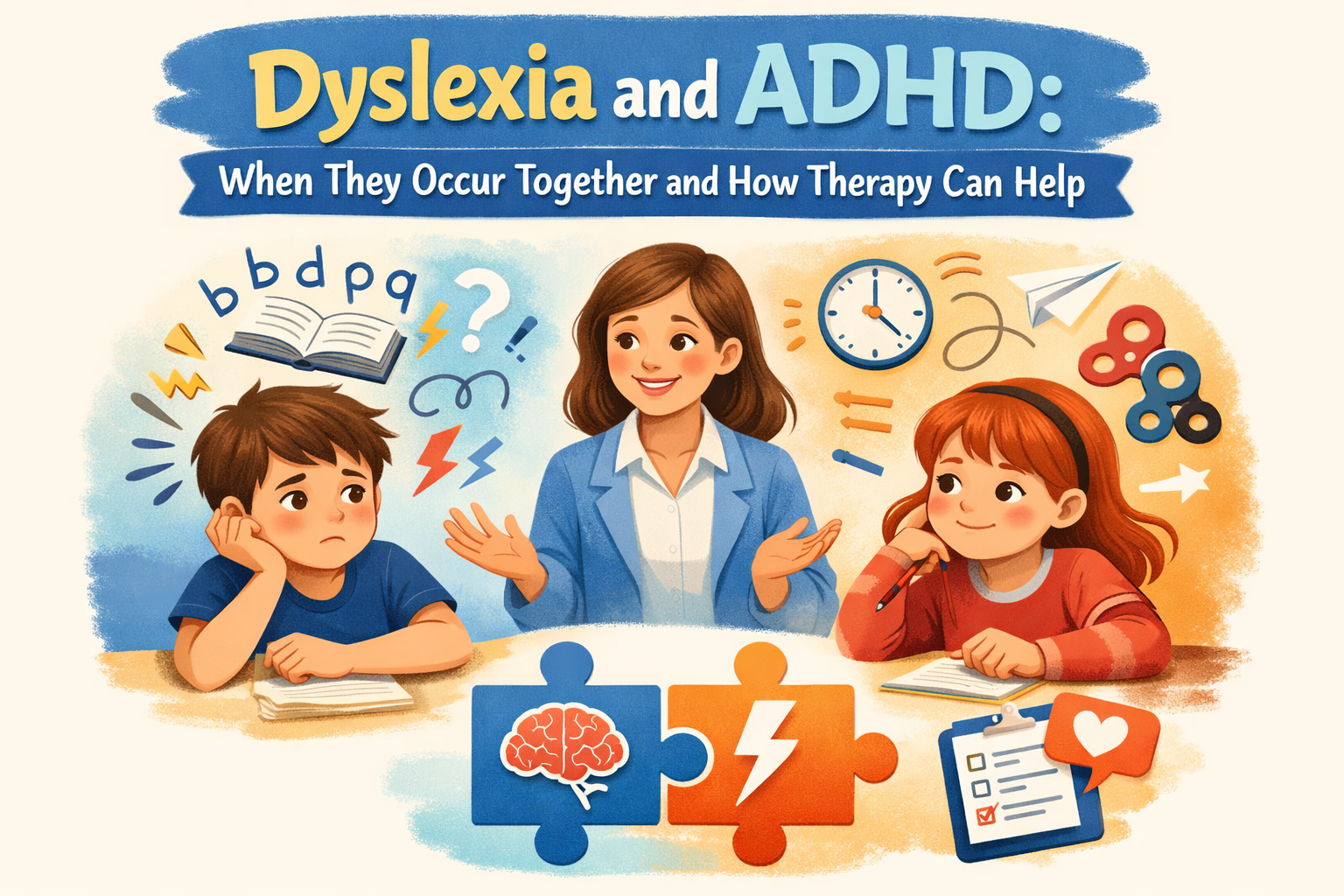
Dyslexia and ADHD: When They Occur Together and How Therapy Can Help
For a long time, dyslexia and ADHD were treated as entirely separate concerns — one belonging to education, the other to psychology. In reality, for a significant number of people, they show up together. And when they do, the experience can be particularly confusing, exhausting, and — without the right support — deeply damaging to how a person sees themselves.
If you are an adult who has spent years wondering why certain things feel so much harder for you than they seem to for everyone else, or a parent watching your child struggle in ways that do not quite fit any single explanation, this post is for you.
How Common Is the Overlap?
Research suggests that around 40% of people with dyslexia also meet the criteria for ADHD, and vice versa. Despite this, many people receive a diagnosis of one without ever being assessed for the other — leaving half the picture missing.
Both conditions are neurodevelopmental, meaning they relate to the way the brain is wired rather than to intelligence, effort, or character. Both are also highly heritable, which is why it is not unusual for a parent to recognise themselves in their child's diagnosis, or for an adult's own assessment to follow closely on the heels of their child's.
Understanding that these two conditions frequently travel together is the first step towards making sense of an experience that may have felt baffling for years.
What Each Condition Actually Involves
Before looking at how they interact, it helps to be clear about what we mean by each.
Dyslexia is a specific learning difference that primarily affects reading, spelling, and the processing of written language. It has nothing to do with vision or intelligence — many people with dyslexia are highly creative, verbally articulate, and capable of sophisticated thinking. The difficulty lies in the way the brain processes the sounds that make up words, which makes decoding written text effortful in a way it simply is not for most people.
ADHD — and particularly the inattentive presentation that is so often missed — affects attention regulation, working memory, impulse control, and the ability to manage time and organise tasks. It is not about being hyperactive or badly behaved (though it can present that way in some people). It is about a brain that struggles to sustain focus on demand, that loses track of things, that finds transitions and structure genuinely difficult.
When both are present, you get a combination of difficulties with reading and written language on one side, and attention, organisation, and self-regulation on the other. In a world built around reading, writing, and sustained concentration, this can feel relentless.
What It Looks Like in Real Life
For children, the combination of dyslexia and ADHD often shows up at school first — but not always in straightforward ways.
A child might be described as bright but not reaching their potential. They may avoid reading aloud, take far longer than expected to complete written work, lose track of instructions, forget to hand in homework they did actually do, or become disruptive in lessons that feel overwhelming. Teachers may interpret these behaviours as laziness, attitude, or lack of effort — assessments that can be profoundly damaging to a child who is already working twice as hard as their peers just to keep up.
For adults, the picture is often one of accumulated exhaustion and confusion. Many adults with undiagnosed dyslexia and ADHD have developed sophisticated strategies to cope — relying heavily on memory, avoiding situations that require reading or writing, building careers around their verbal and creative strengths. From the outside, they may appear capable and successful. Inside, they are often running on empty, haunted by a sense that they are somehow fraudulent, and bewildered by the gaps between their evident abilities and the tasks they find genuinely hard.
The Emotional and Psychological Impact
This is where therapy becomes most relevant — because the practical challenges of dyslexia and ADHD are only part of the story.
Shame is one of the most consistent features of both conditions, particularly when diagnosis has come late or not at all. Years of being told — explicitly or implicitly — that you are not trying hard enough, that you are careless, forgetful, or slow, leaves a mark. Many adults carry a deep and largely unconscious belief that they are fundamentally less capable or less intelligent than other people.
Anxiety is extremely common alongside both dyslexia and ADHD. The anticipation of situations where difficulties might be exposed — a form to fill in, a meeting requiring note-taking, a situation requiring quick reading — can generate real dread. Over time, avoidance patterns build up that significantly limit a person's life.
Low self-esteem is almost universal in people who have spent years struggling without understanding why. When you do not have an explanation for why things are hard, the natural conclusion is that something is wrong with you. That belief, formed often in childhood, tends to persist long into adulthood even after diagnosis.
Emotional dysregulation — difficulty managing frustration, overwhelm, and strong feelings — is particularly associated with ADHD, and it can make the already-challenging experience of navigating a dyslexia-unfriendly world feel even more fraught. Parents may recognise this in their child as meltdowns, explosive reactions to seemingly small things, or rapid mood shifts.
For children, the emotional impact is often visible in school refusal, plummeting confidence, social withdrawal, or increasing anxiety around learning. For adults, it may have hardened into years of self-doubt, avoidance, or a persistent low-level sense of not quite belonging.
How Therapy Can Help
Therapy does not treat dyslexia or ADHD directly — that is the role of specialist educational support, occupational therapy, and in some cases medication. But therapy addresses something equally important: the way these conditions have shaped a person's relationship with themselves.
For adults, therapy offers a space to finally make sense of a lifetime of experiences through a different lens. Understanding that the struggles were neurological rather than personal can be genuinely transformative — but insight alone does not automatically undo years of internalised shame. Therapy helps to work through those beliefs more slowly and thoroughly, rebuilding a sense of self-worth that is not contingent on performing in ways the brain was never wired for.
Therapy can also help with the anxiety that has often grown up around avoided situations, the relationship difficulties that can stem from emotional dysregulation or communication differences, and the burnout that frequently accompanies years of masking and overcompensating.
For parents, therapy — or therapeutic support — can provide a space to process the emotions that come with a child's diagnosis. Many parents feel guilt, grief, overwhelm, or their own unresolved feelings if the diagnosis mirrors their own experience. Therapy can help parents support their child from a steadier, more informed place rather than one of anxiety or self-blame.
For children and young people themselves, play therapy, creative therapies, or age-appropriate talking therapy can offer a space to process the difficult feelings around school and learning — to feel genuinely seen and understood rather than managed or corrected.
Getting Support in Falmouth and Cornwall
If you are based in Falmouth, Penryn, Truro, or elsewhere in Cornwall and are navigating the impact of dyslexia, ADHD, or both — whether in your own life or your child's — we would be glad to talk.
Therapy will not make reading easier or sharpen attention overnight. But it can change the story a person tells themselves about who they are and what they are capable of — and that often turns out to be the most important shift of all.
You are welcome to get in touch for an initial conversation. There is no pressure to have everything figured out before you reach out.
Related reading
More from the blog
Need Support?
If you're ready to take the next step, we're here to help