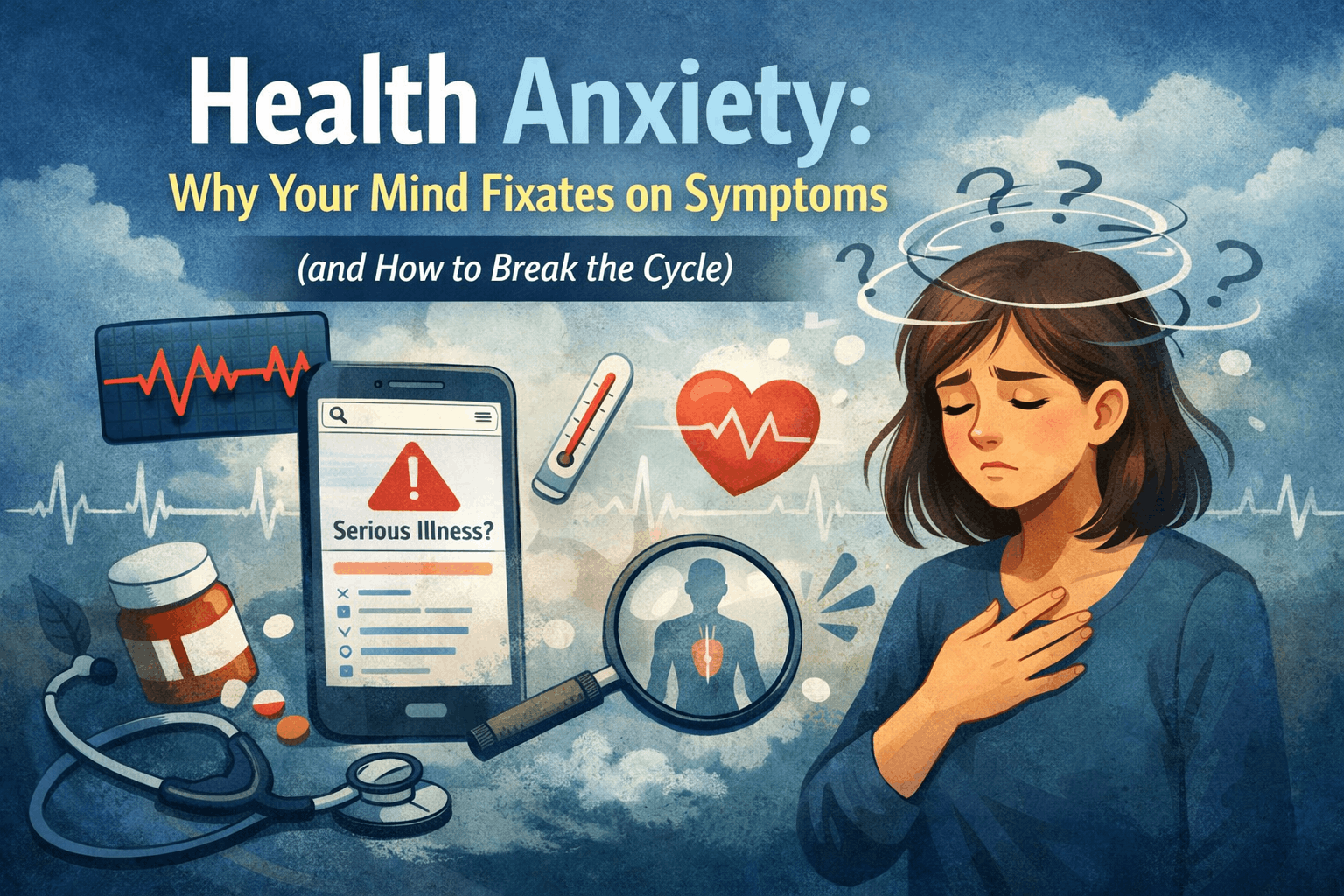
Health Anxiety: Why Your Mind Fixates on Symptoms (and How to Break the Cycle)
Have you ever noticed a small physical symptom—like a headache, tight chest, or strange sensation—and found your mind spiralling into worst-case scenarios?
You might Google it. Check your body repeatedly. Ask others for reassurance. And even when you’re told “you’re fine,” the worry doesn’t fully go away.
If this sounds familiar, you’re not alone. This pattern is often linked to health anxiety, and it can feel incredibly real, convincing, and exhausting.
In this article, we’ll explore what health anxiety is, why your mind fixates on symptoms, and how therapy can help you break the cycle.
What Is Health Anxiety?
Health anxiety involves a persistent fear or worry about your health, often focused on the belief that something is seriously wrong with your body.
It’s not about “making it up” or being dramatic. The sensations you notice are real—but the meaning your mind attaches to them becomes amplified.
You might experience:
-
Constant body checking (heart rate, lumps, breathing)
-
Frequent Googling of symptoms
-
Difficulty being reassured by doctors or tests
-
Fear that something has been missed
-
A cycle of temporary relief followed by renewed worry
Over time, this can become mentally draining and start to impact your day-to-day life.
Why Your Brain Fixates on Symptoms
From a psychological perspective, health anxiety is less about your body—and more about how your brain is trying to protect you.
Your mind is constantly scanning for danger. When it becomes sensitised, it starts to treat normal bodily sensations as potential threats.
Here’s how the cycle typically works:
-
You notice a sensation (e.g. tight chest)
-
Your brain interprets it as dangerous (“What if it’s serious?”)
-
Anxiety increases
-
Your body produces more sensations (due to stress)
-
You become more aware of your body
-
The cycle reinforces itself
This is why health anxiety can feel so convincing. The more attention you give your body, the more you notice—and the more “evidence” your brain thinks it has.
The Role of Google and Reassurance
In today’s world, health anxiety is often fuelled by constant access to information.
You might find yourself:
-
Searching symptoms late at night
-
Comparing your experience to worst-case scenarios
-
Looking for reassurance from friends or professionals
While this can bring short-term relief, it often makes things worse in the long run.
Why?
Because reassurance teaches your brain:
“This is something to be worried about.”
So it keeps coming back.
Why It Feels So Real (Even When You “Know” It’s Anxiety)
One of the hardest parts of health anxiety is the disconnect between logic and feeling.
You might think:
“I know this is probably anxiety…”
But still feel:
“What if it isn’t this time?”
This happens because anxiety operates on a felt sense of threat, not just rational thought.
Your nervous system is activated. Your body feels different. And your brain tries to make sense of that by finding a cause.
So even when part of you understands what’s happening, another part still feels unsafe.
How Therapy Helps with Health Anxiety
Therapy isn’t about convincing you “nothing is wrong.”
It’s about helping you change your relationship with uncertainty, sensations, and fear.
In person-centred counselling, we focus on understanding your experience—not dismissing it.
Over time, therapy can help you:
1. Break the Attention Loop
You learn how your focus on your body is maintaining the anxiety—and how to gently shift it.
2. Reduce Reassurance-Seeking
Rather than constantly needing certainty, you begin to tolerate uncertainty in a healthier way.
3. Understand the Underlying Anxiety
Health anxiety often connects to deeper themes like:
-
Fear of loss or death
-
Lack of control
-
Past experiences with illness
Exploring these can reduce the intensity of the symptoms.
4. Rebuild Trust in Your Body
Instead of seeing your body as something fragile or dangerous, you start to feel safer within it.
Simple Ways to Start Breaking the Cycle
While therapy offers deeper support, there are small steps you can begin with:
-
Notice the urge to Google (without acting on it immediately)
-
Label the thought: “This is anxiety talking”
-
Shift your attention outward (movement, conversation, environment)
-
Limit body checking behaviours
-
Be compassionate with yourself—this isn’t a choice, it’s a pattern
Change doesn’t happen overnight, but even small shifts can reduce the intensity over time.
Health Anxiety in a Place Like Falmouth
Living in a coastal town like Falmouth can be grounding—but it can also feel isolating when you’re stuck in your own thoughts.
You might appear calm on the outside, while internally dealing with constant worry.
Reaching out for support locally can make a real difference. Therapy offers a space where you don’t have to manage it alone—and where your experience is taken seriously.
Looking for Therapy in Falmouth?
If you’re struggling with health anxiety, you don’t have to keep second-guessing yourself or living in constant worry.
At New Ground Therapy, I offer a calm, non-judgemental space to explore what’s going on and help you move towards a greater sense of ease.
You’re welcome to get in touch for an initial conversation and see if it feels like the right fit.
Related reading
More from the blog
Need Support?
If you're ready to take the next step, we're here to help